Archive for the ‘first’ tag
Quantum Machines opens the Israeli Quantum Computing Center – PR Newswire
Posted: July 1, 2024 at 2:33 am
A core part of the Israel Innovation Authority's Israel National Quantum Initiative, the center is the first to tightly integrate multiple types of quantum computers with supercomputers using NVIDIA DGX Quantum
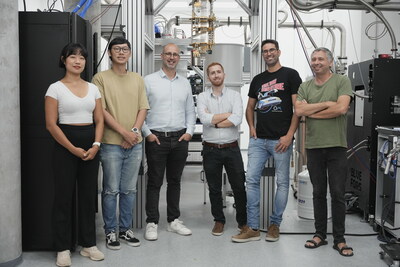
TEL AVIV, Israel, June 25, 2024 /PRNewswire/ -- Quantum Machines (QM), the leading provider of processor-based quantum controllers, announced the opening of the Israeli Quantum Computing Center (IQCC), a world-class research facility that will serve the quantum computing industry and academic community in Israel and around the world. The center was built with the financial backing and support of the Israel Innovation Authority and is located at Tel Aviv University.
The IQCC's grand opening took place yesterday, June 24th, as part of Tel Aviv University's AI and Cyber Week. The ceremony began with the ribbon-cutting, followed by speeches from Asaf Zamir, First Deputy Mayor of Tel Aviv; Dror Bin, CEO of the Israel Innovation Authority; Prof. Yaron Oz and Prof. Itzik Ben Israel from Tel Aviv University; and Dr. Itamar Sivan, CEO of Quantum Machines. Industry experts, including Eyal Waldman, co-founder and former CEO of Mellanox, Ofir Zamir, Senior Director of AI Solution Architecture at NVIDIA, and Niv Efron, Senior Director of Engineering at Google, also shared their insights.
About the IQCC:
In the global race to develop practical quantum computing, access to cutting-edge facilities is crucial. "All of the world's most advanced quantum computing research facilities are closed or offer very limited access to those outside of their organization. You can't compete if you need to fly halfway around the world for limited access," said Dr. Itamar Sivan, CEO and co-founder of Quantum Machines. "When we thought about what would propel quantum computing forward, we realized that building the most advanced facility in terms of interoperability, modularity, and integration with high-performance computing (HPC) and the cloud was the way to go. Our open architecture approach will ensure that the facility can be continuously upgraded and scaled to stay at the cutting edge, making it an accelerator for the entire ecosystem in Israel and internationally."
The IQCC is a state-of-the-art quantum and HPC center that uniquely integrates the power of quantum and classical computing resources. It is the first in the world to house multiple co-located quantum computers of different qubit types, all utilizing the NVIDIA DGX Quantum system. This offers on-premises supercomputing resources and cloud accessibility, while being tightly integrated with Quantum Machines' processor-based OPX control system. The center also features the world's best-equipped testbed for developing new quantum computing technologies.
The unified DGX Quantum system for integrated quantum supercomputing was co-developed by NVIDIA and Quantum Machines. DGX Quantum implements NVIDIA CUDA-Q, an open-source software platform for integrated quantum-classical computing. The system features a supercomputing cluster headlined by NVIDIA Grace Hopper superchips and also including NVIDIA DGX H100, all connected to AWS cloud platforms for remote access and to leverage additional cloud computing resources. The center also utilizes QM's new OPX1000 controller, designed to enable scaling to 1,000+ qubits.
"The tight integration of quantum computers with AI supercomputers is essential to the development of useful quantum computing," said Tim Costa, Director of Quantum and HPC at NVIDIA. "This work with Quantum Machines to enable a flagship deployment of NVIDIA DGX Quantum in the IQCC offers researchers the platform they need to grow quantum computing into the era of large-scale, useful applications"
"Before the IQCC, a developer of a quantum processor chip would need to build their own testing setup, costing millions," said Dr. Yonatan Cohen, CTO and co-founder of Quantum Machines. "Now, researchers can plug their chip into our testbed and benefit from the most advanced setup in the world, leveraging NVIDIA and Quantum Machines hardware to accelerate their development process and reduce costs significantly."
The IQCC is open to researchers and developers of quantum computers from around the world. By providing an open, cutting-edge platform for research and development, Quantum Machines aims to accelerate the progress of practical quantum computing and foster collaborative projects with industry leaders that will drive the field forward. The center is poised to become a destination for companies and researchers worldwide, securing Israel's quantum independence and cementing its position as a leader in the quantum computing revolution.
For more information about the IQCC please visit https://i-qcc.com/.
Additional information on technology and partners:
ContactGavriel Cohen Concrete Media for Quantum Machines[emailprotected]
Photo - https://mma.prnewswire.com/media/2447560/Quantum_Machines.jpg
SOURCE Quantum Machines
More:
Quantum Machines opens the Israeli Quantum Computing Center - PR Newswire
How Quantum Computing Is Already Changing the World – InvestorPlace
Posted: at 2:33 am
Editors note: How Quantum Computing Is Already Changing the World was previously published in May 2024. It has since been updated to include the most relevant information available.
Im a history junkie. So, in this Monday issue of Hypergrowth Investing, let me share an interesting story that I bet a lot of you have never heard before.
And interestingly enough, it could be the key to helping you capitalize on the AI Revolution.
Back in October of 1927, the worlds leading scientists descended upon Brussels for the fifthSolvay Conference an exclusive, invite-only conference that is dedicated to discussing and solving the outstanding preeminent open problems in physics and chemistry.
In attendance were scientists that, today, we praise as the brightest minds in the history of mankind.
Albert Einstein was there; so was Erwin Schrodinger, who devised the famous Schrodingers cat experiment, and Werner Heisenberg, the man behind the world-changing Heisenberg uncertainty principle and Louis de Broglie, Max Born, Niels Bohr, Max Planck.
The list goes on and on. Of the 29 scientists who met in Brussels in October 1927, 17 of them went on to win a Nobel Prize.
These are the minds that collectively created the scientific foundation upon which the modern world is built.
And yet, when they all descended upon Brussels nearly 94 years ago, they were stumped by one concept. Its one that, for nearly a century, has remained the elusive key to unlocking humankinds full potential.
And now, for the first time ever, that concept is turning into a disruptive reality through breakthrough technology that will change the world as we know it.
So what exactly were Einstein, Schrodinger, Heisenberg and the rest of those Nobel laureates talking about in Brussels back in 1927?
Quantum mechanics.
Ill start by saying that the underlying physics of this breakthrough quantum mechanics is highly complex. It would likely require over 500 pages to fully understand.
But, alas, heres my best job at making a Cliffs Notes version in 500 words instead.
For centuries, scientists have developed, tested, and validated the laws of the physical world, known as classical mechanics. These scientifically explain how and why things work, where they come from, so on and so forth.
But in 1897, J.J. Thomson discovered the electron. And he unveiled a new, subatomic world of super-small things that didnt obey the laws of classical mechanics at all. Instead, they obeyed their own set of rules, which have since become known as quantum mechanics.
The rules of quantum mechanics differ from that of classical mechanics in two very weird, almost-magical ways.
First, in classical mechanics, objects are in one place at one time. You are either at the store or at home, not both.
But in quantum mechanics, subatomic particles can theoretically exist in multiple places at once before theyre observed. A single subatomic particle can exist in point A and point B at the same time until we observe it. And at that point, it only exists at either point A or point B.
So, the true location of a subatomic particle is some combination of all its possible positions.
This is calledquantumsuperposition.
Second, in classical mechanics, objects can only work with things that are also real. You cant use an imaginary friend to help move the couch. You need a real friend instead.
But in quantum mechanics, all of those probabilistic states of subatomic particles are not independent. Theyre entangled. That is, if we know something about the probabilistic positioning of one subatomic particle, then we know something about the probabilistic positioning of another subatomic particle meaning that these already super-complex particles can actually work together to create a super-complex ecosystem.
This is called quantum entanglement.
So in short, subatomic particles can theoretically have multiple probabilistic states at once, and all those probabilistic states can work together again, all at once to accomplish their task.
And that, in a nutshell, is the scientific breakthrough that stumped Einstein back in the early 1900s.
It goes against everything classical mechanics had taught us about the world. It goes against common sense. But its true. Its real. And now, for the first time ever, we are learninghow to harness this unique phenomenon to change everything about everything
This is why the U.S. government is pushing forward on developing a National Quantum Internet in southwest Chicago. It understands that this tech could be more revolutionary than the discovery of fire or the invention of the wheel.
I couldnt agree more.
Mark my words. Everything will change over the next few years because of quantum mechanics and some investors will make a lot of money.
The study of quantum theory has led to huge advancements over the past century. Thats especially true over the past decade. Scientists at leading tech companies have started to figure out how to harness the power of quantum mechanics to make a new generation of superquantum computers.And theyre infinitely faster and more powerful than even todays fastest supercomputers.
Again, the physics behind quantum computers is highly complex, but heres my shortened version
Todays computers are built on top of the laws of classical mechanics. That is, they store information on what are calledbits, which can store data binarily as either 1 or 0.
But what if you could turn those classical bits into quantum bits qubits to leverage superpositioning to be both 1 and 0 stores at once?
Further, what if you could leverage entanglement and have all multi-state qubits work together to solve computationally taxing problems?
Theoretically, youd create a machine with so much computational power that it would make todays most advanced supercomputers seem ancient.
Thats exactly whats happening today.
Googlehas built a quantum computer that is about158 million times fasterthan the worlds fastest supercomputer.
Thats not hyperbole. Thats a real number.
Imagine the possibilities if we could broadly create a new set of quantum computers that are 158 million times faster than even todays fastest computers
Imagine what AI could do.
Today, AI is already being used to discover and develop new drugs and automate manual labor tasks like cooking, cleaning, and packaging products. It is already being used to write legal briefs, craft ads, create movie scripts, and more.
And thats with AI built on top of classical computers.
But built upon quantum computers computer that are a 158 million times faster than classical computers AI will be able to donearly everything.
The economic opportunities at the convergence of artificial intelligence and quantum computing are truly endless.
Quantum computing is agame-changerthats flying under the radar.
Its not just another breakthrough its the seismic shift weve been waiting for, rivaling the impact of the internet and the discovery of fire itself.
We think the top stocks at the convergence of AI and QC havea realistic opportunity to soar 1,000%over the next few years alone.
So which stocks should you be buying right now? And which should you be selling?
Those are the billion-dollar questions we need to answer now if we want to make big money from top AI stocks in 2024.
Which is why I went public with all the details aboutArea 52
A stretch of land in the midwest where the U.S. government is covertly testing whats set to becomethe worlds first quadrillion-dollar technology.
In this brief presentation, I reveal the reason this technology could revolutionize everything
And how atiny company poised to bring this breakthrough tech mainstream could 79X your investment in the months ahead
On the date of publication, Luke Lango did not have (either directly or indirectly) any positions in the securities mentioned in this article.
P.S. You can stay up to speed with Lukes latest market analysis by reading our Daily Notes! Check out the latest issue on yourInnovation InvestororEarly Stage Investorsubscriber site.
See the original post here:
How Quantum Computing Is Already Changing the World - InvestorPlace
U.S. Added 272K Jobs in May, Blowing Past Estimates; Bitcoin Pulls Back From 2-Month High – CoinDesk
Posted: June 11, 2024 at 2:49 am
The employment market in the U.S. remained strong in May with the government reporting the addition of 272,000 jobs, far past estimates for just 185,000 and well ahead of April's 165,000 (revised from a previously reported 175,000).
The May unemployment rate was 4.0% versus estimates for 3.9% and April's 3.9%.
The price of bitcoin (BTC) fell sharply from a two-month high just shy of $72,000 in the minutes following the numbers. At press time, BTC was changing hands at $70,900, down 0.5% over the past 24 hours.
Wage data from this morning's report shows average hourly earnings rising 0.4% in May versus forecasts for 0.3% and April's 0.2%. On a year-over-year basis, average hourly earnings were higher by 4.1% versus estimates for 3.9% and April's 4.0%.
After rising through the first part of 2024, interest rates have been on a downtrend over about the last five weeks as some recent U.S. economic data had pointed to a slowdown in both economic growth and inflation the 10-year Treasury yield ahead of this morning's numbers was at 4.30% versus a 2024 high of 4.71% in late April.
The move down in rates has been a boon for risk assets, with the major U.S. stock market averages surging to record highs and the price of bitcoin rising from about the $60,000 level to within close range of its record high just above $73,500.
Ideas that the major Western economies are about to fully enter a monetary easing cycle received further merit this week when both the Bank of Canada and the European Central Bank slashed their respective benchmark interest rates for the first time in several years. As for the U.S., the odds of a Fed rate cut have risen sharply of late, with investors prior to this morning's report having priced in about a 55% chance of a move on or before the bank's September policy meeting.
With today's strong numbers, much of this thinking is likely to be reversed in at least the short term. In addition to bitcoin's swift pullback, the 10-year Treasury yield has shot higher by 12 basis points to 4.42% and U.S. stock index futures are pointing to a lower open. Checking other indicators, the U.S. dollar has surged 0.5% and gold has tumbled more than 2%.
Bloomberg Chief Economist Anna Wong has an interesting contrary take on the data, suggesting the rise in the unemployment rate is the more important indicator of the reality of the employment situation. "[The government] model for estimating business births and deaths which added 231,000 jobs to the nonfarm-payrolls print in May is lagging the reality of surging establishment closures and falling business formation. We think the underlying pace of current job gains is likely less than 100,000 per month."
Read more here:
U.S. Added 272K Jobs in May, Blowing Past Estimates; Bitcoin Pulls Back From 2-Month High - CoinDesk
‘We Are Lady Parts’ is back for season 2 and it’s an irresistible binge – Tom’s Guide
Posted: June 2, 2024 at 2:45 am
Nearly three years ago, the first season of We Are Lady Parts on Peacock was a blast of giddy energy, with six episodes of punk rock, friendship and solidarity. After a far-too-long wait, the British comedy series is back tomorrow (May 30) with six new episodes, a brief but joyous return to the world of the all-female Muslim punk band Lady Parts. My only disappointment about the season is that its taken so long to arrive, and is over far too quickly.
Where to stream 'We Are Lady Parts'
"We Are Lady Parts" is streaming on Peacock
Lady Parts were just getting started as a band by the end of the first season, but as the second season opens, theyve already completed a U.K. tour and have amassed a decent-size fan base. Creator Nida Manzoor, who writes and directs every episode, smartly moves the story forward while retaining the character-focused approach that made the first season so appealing. Lady Parts may be getting famous, but that doesnt solve any of the individual band members personal problems.
Although lead guitarist Amina (Anjana Vasan) is still clearly the main character, anchoring every episode with her Sex and the City-style narration, season 2 offers extended arcs for all four band members, plus manager Momtaz (Lucie Shorthouse). Its a bit more balanced than the first season, which spent much of its time on Aminas internal conflict over whether to join the band.
Everyone in Lady Parts is now firmly committed to the band, and one of the seasons greatest strengths is that its always a celebration of their personal and artistic connection, even when faced with outside challenges.
Newly confident, Amina declares that shes in her villain era and goes after what she wants, even though shes not always sure what that is. Shes still pining for Ahsan (Zaqi Ismail), the brother of Lady Parts drummer Ayesha (Juliette Motamed), although she ends up dating his white co-worker instead. Romantic indecision aside, shes more assertive and ambitious this season, and that gives the show space for the other characters to deal with their own issues.
Ayesha is happy in a new relationship with an outgoing, supportive woman, but she still hasnt been able to come out to her parents. Bassist Bisma (Faith Omole) struggles with her self-image as a responsible wife and mother but also a rebellious punk rocker, and shes showcased in some of the seasons most eye-catching set pieces. Band frontwoman Saira (Sarah Kameela Impey) continues to fight for Lady Parts integrity, even as shes tempted by the prospect of a high-powered manager and a deal with a major record label.
Even Momtaz, who was more of a background presence in the first season, gets her own empowering arc, as she examines her place in Lady Parts career and the music industry as a whole. Aspects of the industry storyline feel rushed, given the limited number of episodes and their short running times, but Manzoor captures the entire life cycle of an up-and-coming band thrilled by the prospect of stardom, then disillusioned by corporate interference.
During the long break between seasons of We Are Lady Parts, Manzoor wrote and directed the action-comedy feature film Polite Society, and she brings some of that grand, stylized approach to the musical sequences in the new season. The first season had its share of catchy songs, but season 2 features even more original music, including an improbably rousing number about responding to work emails at a reasonable hour.
Lady Parts is a punk band, but their original songs in season 2 feature touches of country and rockabilly, too, and theyre catchy and fun while getting across the adversity that the characters often face as Muslim women in the U.K.
Manzoor, who writes the original songs with her siblings, also makes brilliant use of some unlikely covers: Amina brings poignancy to her solo rendition of Extremes More Than Words, Lady Parts rocks out to a hard-hitting version of Britney Spears Oops! I Did It Again while playing a for-hire gig at a wedding, and Bisma delivers an anguished, slowed-down take on Nina Simones Dont Let Me Be Misunderstood while working through her family issues. The show even comes close to making Hoobastanks goopy power ballad The Reason tolerable during a climactic romantic declaration.
Each song is presented via elaborate musical sequences, with magical-realist touches that make their way into the non-musical scenes as well. Bismas tension with her daughter is represented by a remote control that allows her to literally pause family arguments to vent her frustrations, and Sairas potential censorship by the bands new label manifests itself in her voice being forcefully silenced.
Those heavy moments never drag We Are Lady Parts into sad-com territory, though. This is a comedy that always remembers to be funny, delivering consistently clever jokes while staying true to its characters lived experiences. Bingeing the new season may only offer a short window of time to spend with those characters, but its worth savoring every minute.
Today's best streaming service deals
See the rest here:
'We Are Lady Parts' is back for season 2 and it's an irresistible binge - Tom's Guide
NXP, eleQtron, and ParityQC Deliver a 10 Qubit, Full-Stack Ion-Trap Based Quantum Computer Demonstrator to the DLR Quantum Computing Initiative -…
Posted: at 2:44 am
NXP Semiconductors N.V., eleQtron, and ParityQC, part of the QSea consortium of the DLR Quantum Computing Initiative (DLR QCI), have revealed the first full-stack, 10 qubit, ion-trap based quantum computer demonstrator made entirely in Germany. The quantum computer demonstrator is located in Hamburg, reinforcing the citys role as a significant technology and research hub in Germany. It will enable early access to real quantum computing resources, allowing companies and research teams to leverage quantum computing advantages in applications such as climate modeling, global logistics, and materials sciences.
The QSea I demonstrator combines eleQtrons MAGIC hardware, ParityQC architecture, and NXPs chip design and technology, complemented by a digital twin. The next phase of the QSea project will focus on making the quantum computer increasingly powerful and industry-ready. The demonstrator is set up at the DLR QCI Innovation Center in Hamburg and will be available to industry partners and DLR research teams. This collaboration aims to foster an advanced quantum computing ecosystem in Germany and support digital sovereignty efforts in critical technology areas.
A press release announcing the delivery of this computer has been posted on the parityQC website here. In addition, a blog has been posted here on the DLR QCI website that provides further details about this first project QSea I as well as a follow-on project called QSea II that will create a modular, scalable quantum computer based on multiple ion trap chips connected together.
June 1, 2024
See original here:
NXP, eleQtron and ParityQC Reveal First Quantum Computing Demonstrator For The DLR Quantum Computing Initiative – The Quantum Insider
Posted: at 2:44 am
Insider Brief
PRESS RELEASE NXP Semiconductors N.V., eleQtron and ParityQC, working together in the QSea consortium of the DLR Quantum Computing Initiative (DLR QCI), revealed the first full-stack, ion-trap based quantum computer demonstrator made entirely in Germany. It will enable early access to real quantum computing resources and thus help companies and research teams leverage the advantages of quantum computing in applications such as climate modeling, global logistics and materials sciences. The new quantum computer demonstrator is located in Hamburg, further strengthening the citys role as an important technology and research location in Germany.
A broader understanding of the capabilities of quantum computing is required for this technology to be effective in solving complex challenges. The DLR QCI aims to build the necessary skills by creating a quantum computing ecosystem in which economy, industry and science cooperate closely to fully leverage the potential of this groundbreaking technology.
Quantum computers, with their exceptional computing power, will tackle complex problems crucial for societal advancement, such as weather modeling, medication development, and logistics optimization, and are expected to change the cybersecurity landscape. Despite the rapid evolution of quantum computers over the past years, the path towards industrialization remains challenging, as the industry lacks respective competencies.
NXP, eleQtron and ParityQC bring together leading knowledge of quantum computing, software and long-standing industry expertise to develop and build the first ion-trap based quantum computer demonstrator made entirely in Germany. It combines eleQtrons MAGIC hardware, ParityQC architecture and NXPs chip design and technology, and is complemented by a digital twin. This will allow for rapid innovation, design decisions and implementation, as the QSea I demonstrator will evolve to a quantum computer including a modular architecture, scalable design and error correction capabilities. The forthcoming phase of the QSea project will therefore focus on making the quantum computer increasingly powerful and industry-ready.
The demonstrator is set up at the DLR QCI Innovation Center in Hamburg and will be made available to industry partners and DLR research teams by the DLR QCI. With this collaboration, the three partners and the DLR QCI aim to foster and strengthen the development of an advanced quantum computing ecosystem in Germany. This will also support the strategic efforts of Germany and the European Union to strengthen digital sovereignty in this critical technology area.
Quotes
Lars Reger, CTO at NXP Semiconductors: Hamburg is one of our most important R&D locations. We are proud that, together with DLR and our partners eleQtron and ParityQC, we are able to present the first ion-trap based quantum computer demonstrator developed entirely in Germany. We are convinced that industry and research communities in Hamburg and throughout Germany will benefit from this project. It will help to build up and expand important expertise in quantum computing, to use it for the economic benefit of us all, and also to further strengthen our digital sovereignty in Germany and the EU.
Jan Leisse, Co-Founder & CEO at eleQtron: We at eleQtron believe that quantum computing will change our world for the better. The DLR Quantum Computing Initiative has the potential to become something truly great, and our pioneering MAGIC-based quantum computer lays the foundation for a vibrant ecosystem. As Germanys first quantum computing hardware company, we are proud to bring research excellence into the real world.
Dr.-Ing. Robert Axmann, Head of DLR Quantum Computing Initiative (DLR QCI): To achieve a leading international position in quantum computing, we need a strong quantum computing ecosystem. Only together will research, industry and start-ups overcome the major technological challenges and successfully bring quantum computers into application. The QSea I demonstrator is an important step for the DLR Quantum Computing Initiative and for Hamburg. It enables partners from industry and research to run quantum algorithms on real ion trap qubits in a real production environment for the first time. This hands-on experience will enable them to leverage the advantages of quantum computers and become part of a strong and sovereign quantum computing ecosystem in Germany and Europe.
Wolfgang Lechner & Magdalena Hauser, Co-CEOs at ParityQC: With the purchase of quantum computers by the DLR QCI, financed by the BMWK, Germany is consolidating its leading role in quantum computing. This is a critical pathway towards the successful commercialization of world-leading research and the creation of a sustainable quantum ecosystem that allows companies to scale and stay in Europe. As a quantum architecture company, we enable hardware developers to build highly scalable quantum computers and we are proud to be able to do this with our excellent partners in this consortium.
View original post here:
NXP, eleQtron and ParityQC Reveal Quantum Computing Demonstrator – Embedded Computing Design
Posted: at 2:44 am
By Ken Briodagh
Senior Technology Editor
Embedded Computing Design
May 30, 2024
News
According to a recent release, NXP Semiconductors has partnered with eleQtron and ParityQC, with theQSea consortiumof theDLR Quantum Computing Initiative (DLR QCI), to create what is reportedly the first full-stack, ion-trap based quantum computer demonstrator made entirely in Germany. The new quantum computer demonstrator is in Hamburg.
Hamburg is one of our most important R&D locations. We are proud that, together with DLR and our partners eleQtron and ParityQC, we are able to present the first ion-trap based quantum computer demonstrator developed entirely in Germany, said Lars Reger, CTO at NXP Semiconductors. We are convinced that industry and research communities in Hamburg and throughout Germany will benefit from this project. It will help to build up and expand important expertise in quantum computing, to use it for the economic benefit of us all, and also to further strengthen our digital sovereignty in Germany and the EU.
The goal of this demonstrator is to enable early access to quantum computing resources and help companies and research teams leverage it for applications like climate modeling, global logistics and materials sciences, the companies said.
DLR QCI says it aims to build necessary skills by creating a quantum computing ecosystem in which economy, industry and science cooperate closely to fully leverage the potential of this technology. Quantum computers are expected to tackle complex problems across industries, and will likely dramatically change the cybersecurity landscape.
NXP, eleQtron and ParityQC have used their expertise to build this ion-trap based quantum computer demonstrator by combining eleQtrons MAGIC hardware, ParityQC architecture, and NXP chip design and technology. To speed innovation and iteration, they have also developed a digital twin, which reportedly will be used to help this QSea I demonstrator to evolve to a quantum computer with a modular architecture, scalable design, and error correction capabilities. That evolution will be the goal of the ongoing work with the project.
The demonstrator is set up at the DLR QCI Innovation Center in Hamburg and will be made available to industry partners and DLR research teams, the release said. The three partners and the DLR QCI say they aim to foster and strengthen the development of an advanced quantum computing ecosystem in Germany.
To achieve a leading international position in quantum computing, we need a strong quantum computing ecosystem. Only together will research, industry and start-ups overcome the major technological challenges and successfully bring quantum computers into application. The QSea I demonstrator is an important step for the DLR Quantum Computing Initiative and for Hamburg. It enables partners from industry and research to run quantum algorithms on real ion trap qubits in a real production environment for the first time. This hands-on experience will enable them to leverage the advantages of quantum computers and become part of a strong and sovereign quantum computing ecosystem in Germany and Europe, said Dr.-Ing. Robert Axmann, Head of DLR Quantum Computing Initiative (DLR QCI).
Ken Briodagh is a writer and editor with two decades of experience under his belt. He is in love with technology and if he had his druthers, he would beta test everything from shoe phones to flying cars. In previous lives, hes been a short order cook, telemarketer, medical supply technician, mover of the bodies at a funeral home, pirate, poet, partial alliterist, parent, partner and pretender to various thrones. Most of his exploits are either exaggerated or blatantly false.
More from Ken
Visit link:
NXP, eleQtron and ParityQC Reveal Quantum Computing Demonstrator - Embedded Computing Design
What Teaching Thousands in Quantum Taught One Rising STEM Leader – The Quantum Insider
Posted: at 2:44 am
Sanskriti Deva, an Indian-American quantum engineer and passionate STEM educator, has an extraordinary story to share. Having taught over 10,000 people about the fascinating realm of quantum computingfrom elementary schoolers to industry professionalsher journey has yielded profound lessons that transcend scientific boundaries.
For Deva, who at 17 became one of the youngest elected officials and got to bring a lot of youth engagement to the United Nations as a member of Gen Z, the path to quantum enlightenment began with an unlikely source of inspirationsuperhero movies.
Im a really big comic fan and I love the Marvel Cinematic Universe. I kept hearing that word [quantum] over and over again I became more interested in what it meant, she explained during a recent TEDx talk at North Carolina State University.
However, Devas initial self-doubt nearly prevented her from embarking on this quantum adventure.
Honestly, if you had asked me like five years ago if I would be on stage talking about quantum computers, I would have said no, thats impossible. Im not smart enough, she admitted. It was her students who helped her overcome this mindset, leading to her first powerful realization: You dont have to be an innate genius or super talented at something to pursue something that youre passionate about.
Devas second lesson came from witnessing her students shared struggles and triumphs.
I learned this when I started teaching quantum computing for the first timeit was honestly the first time I had interacted with other people that were interested in the same subject I was, she said. There are people out there who like the same thing you do, regardless of how niche it is, and there are people out there that are also facing the same issues that you are as well.
But it was her youngest pupils who imparted perhaps the most profound wisdom.
They raised their hand and they said, I want to be a quantum computing princess ballerina dancer boxer president, or they said something like, Why not? I thought this would be cool, Deva recounted. From their unencumbered perspectives, she realized: You dont have to just choose one thing. You can be a multitude of things.
Reflecting on this revelation, Deva expressed that she believes our quality of life improves when we, like quantum particles that exist in dual states, embrace our multitude of identities and our multifaceted nature.
She passionately urged her audience: I encourage you to become an engineer and an artist, a scientist and a storyteller, a princess and a president.
Sanskriti Devas extraordinary journey from aspiring quantum student to esteemed educator has yielded profound insights into the boundless potential of curiosity, community, and self-acceptance. Her inspirational call to embrace the superposition of our multidimensional identities resonates far beyond the realm of quantum physics, reminding us all to fearlessly explore the infinite possibilities that lie within.
Featured image: Credit: TEDx
More here:
What Teaching Thousands in Quantum Taught One Rising STEM Leader - The Quantum Insider
Glimpse of Next-Generation Internet – The Good Men Project
Posted: at 2:44 am
By Anne J. Manning, Harvard Gazette
Its one thing to dream up a next-generation quantum internet capable of sending highly complex, hacker-proof information around the world at ultra-fast speeds. Its quite another to physically show its possible.
Thats exactly what Harvard physicists have done, using existing Boston-area telecommunication fiber, in a demonstration of the worlds longest fiber distance between two quantum memory nodes. Think of it as a simple, closed internet carrying a signal encoded not by classical bits like the existing internet, but by perfectly secure, individual particles of light.
Thegroundbreaking work, published in Nature, was led by Mikhail Lukin, the Joshua and Beth Friedman University Professor in the Department of Physics, in collaboration with Harvard professorsMarko LonarandHongkun Park,who are all members of theHarvard Quantum Initiative.The Naturework was carried out with researchers atAmazon Web Services.
The Harvard team established the practical makings of the first quantum internet by entangling two quantum memory nodes separated by optical fiber link deployed over a roughly 22-mile loop through Cambridge, Somerville, Watertown, and Boston. The two nodes were located a floor apart in Harvards Laboratory for Integrated Science and Engineering.
Quantum memory, analogous to classical computer memory, is an important component of a quantum computing future because it allows for complex network operations and information storage and retrieval. While other quantum networks have been created in the past, the Harvard teams is the longest fiber network between devices that can store, process, and move information.
Each node is a very small quantum computer, made out of a sliver of diamond that has a defect in its atomic structure called a silicon-vacancy center. Inside the diamond, carved structures smaller than a hundredth the width of a human hair enhance the interaction between the silicon-vacancy center and light.
The silicon-vacancy center contains two qubits, or bits of quantum information: one in the form of an electron spin used for communication, and the other in a longer-lived nuclear spin used as a memory qubit to store entanglement, the quantum-mechanical property that allows information to be perfectly correlated across any distance.
(In classical computing, information is stored and transmitted as a series of discrete binary signals, say on/off, that form a kind of decision tree. Quantum computing is more fluid, as information can exist in stages between on and off, and is stored and transferred as shifting patterns of particle movement across two entangled points.)
Using silicon-vacancy centers as quantum memory devices for single photons has been a multiyear research program at Harvard. The technology solves a major problem in the theorized quantum internet: signal loss that cant be boosted in traditional ways.
A quantum network cannot use standard optical-fiber signal repeaters because simple copying of quantum information as discrete bits is impossible making the information secure, but also very hard to transport over long distances.
Silicon-vacancy-center-based network nodes can catch, store, and entangle bits of quantum information while correcting for signal loss. After cooling the nodes to close to absolute zero, light is sent through the first node and, by nature of the silicon vacancy centers atomic structure, becomes entangled with it, so able to carry the information.
Since the light is already entangled with the first node, it can transfer this entanglement to the second node, explained first author Can Knaut, a Kenneth C. Griffin Graduate School of Arts and Sciences student in Lukins lab. We call this photon-mediated entanglement.
Over the last several years, the researchers have leased optical fiber from a company in Boston to run their experiments, fitting their demonstration network on top of the existing fiber to indicate that creating a quantum internet with similar network lines would be possible.
Showing that quantum network nodes can be entangled in the real-world environment of a very busy urban area is an important step toward practical networking between quantum computers, Lukin said.
A two-node quantum network is only the beginning. The researchers are working diligently to extend the performance of their network by adding nodes and experimenting with more networking protocols.
The paper is titled Entanglement of Nanophotonic Quantum Memory Nodes in a Telecom Network. The work was supported by the AWS Center for Quantum Networkings research alliance with the Harvard Quantum Initiative, the National Science Foundation, the Center for Ultracold Atoms (an NSF Physics Frontiers Center), the Center for Quantum Networks (an NSF Engineering Research Center), the Air Force Office of Scientific Research, and other sources.
This story is reprinted with permission from The Harvard Gazette.
***
All Premium Members get to view The Good Men Project with NO ADS.
A $50 annual membership gives you an all access pass. You can be a part of every call, group, class and community. A $25 annual membership gives you access to one class, one Social Interest group and our online communities. A $12 annual membership gives you access to our Friday calls with the publisher, our online community.
Need more info? A complete list of benefits is here.
Photo credit: iStock
Go here to read the rest:
How Quantum Computing Is Already Changing the World – InvestorPlace
Posted: at 2:44 am
[Editors note: How Quantum Computing Is Already Changing the World was previously published in December 2022. It has since been updated to include the most relevant information available.]
Im a history junkie. So, in this special Sunday issue of Hypergrowth Investing, let me share an interesting story that I bet a lot of you have never heard before.
And interestingly enough, it could be the key to helping you capitalize on the AI Revolution.
Back in October of 1927, the worlds leading scientists descended upon Brussels for the fifthSolvay Conference an exclusive, invite-only conference that is dedicated to discussing and solving the outstanding preeminent open problems in physics and chemistry.
In attendance were scientists that, today, we praise as the brightest minds in the history of mankind.
Albert Einstein was there; so was Erwin Schrodinger, who devised the famous Schrodingers cat experiment, and Werner Heisenberg, the man behind the world-changing Heisenberg uncertainty principle and Louis de Broglie, Max Born, Niels Bohr, Max Planck.
The list goes on and on. Of the 29 scientists who met in Brussels in October 1927, 17 of them went on to win a Nobel Prize.
These are the minds that collectively created the scientific foundation upon which the modern world is built.
And yet, when they all descended upon Brussels nearly 94 years ago, they got stumped by one concept. Its one that, for nearly a century, has remained the elusive key to unlocking humankinds full potential.
And now, for the first time ever, that concept is turning into a disruptive reality through breakthrough technology that will change the world as we know it.
So what exactly were Einstein, Schrodinger, Heisenberg and the rest of those Nobel laureates talking about in Brussels back in 1927?
Quantum mechanics.
Ill start by saying that the underlying physics of this breakthrough quantum mechanics is highly complex. It would likely require over 500 pages to fully understand.
But, alas, heres my best job at making a Cliffs Notes version in 500 words instead.
For centuries, scientists have developed, tested, and validated the laws of the physical world, known as classical mechanics. These scientifically explain how and why things work, where they come from, so on and so forth.
But in 1897, J.J. Thomson discovered the electron. And he unveiled a new, subatomic world of super-small things that didnt obey the laws of classical mechanics at all. Instead, they obeyed their own set of rules, which have since become known as quantum mechanics.
The rules of quantum mechanics differ from that of classical mechanics in two very weird, almost-magical ways.
First, in classical mechanics, objects are in one place at one time. You are either at the store or at home, not both.
But in quantum mechanics, subatomic particles can theoretically exist in multiple places at once before theyre observed. A single subatomic particle can exist in point A and point B at the same time until we observe it. And at that point, it only exists at either point A or point B.
So, the true location of a subatomic particle is some combination of all its possible positions.
This is calledquantumsuperposition.
Second, in classical mechanics, objects can only work with things that are also real. You cant use an imaginary friend to help move the couch. You need a real friend instead.
But in quantum mechanics, all of those probabilistic states of subatomic particles are not independent. Theyre entangled. That is, if we know something about the probabilistic positioning of one subatomic particle, then we know something about the probabilistic positioning of another subatomic particle meaning that these already super-complex particles can actually work together to create a super-complex ecosystem.
This is called quantum entanglement.
So in short, subatomic particles can theoretically have multiple probabilistic states at once, and all those probabilistic states can work together again, all at once to accomplish their task.
And that, in a nutshell, is the scientific breakthrough that stumped Einstein back in the early 1900s.
It goes against everything classical mechanics had taught us about the world. It goes against common sense. But its true. Its real. And now, for the first time ever, we are learninghow to harness this unique phenomenon to change everything about everything
This is why the U.S. government is pushing forward on developing a National Quantum Internet in southwest Chicago. It understands that this tech could be more revolutionary than the discovery of fire or the invention of the wheel.
I couldnt agree more.
Mark my words. Everything will change over the next few years because of quantum mechanics and some investors will make a lot of money.
The study of quantum theory has led to huge advancements over the past century. Thats especially true over the past decade. Scientists at leading tech companies have started to figure out how to harness the power of quantum mechanics to make a new generation of superquantum computers.And theyre infinitely faster and more powerful than even todays fastest supercomputers.
Again, the physics behind quantum computers is highly complex, but heres my shortened version
Todays computers are built on top of the laws of classical mechanics. That is, they store information on what are calledbits, which can store data binarily as either 1 or 0.
But what if you could turn those classical bits into quantum bits qubits to leverage superpositioning to be both 1 and 0 stores at once?
Further, what if you could leverage entanglement and have all multi-state qubits work together to solve computationally taxing problems?
Theoretically, youd create a machine with so much computational power that it would make todays most advanced supercomputers seem ancient.
Thats exactly whats happening today.
Googlehas built a quantum computer that is about158 million times fasterthan the worlds fastest supercomputer.
Thats not hyperbole. Thats a real number.
Imagine the possibilities if we could broadly create a new set of quantum computers that are 158 million times faster than even todays fastest computers
Imagine what AI could do.
Today, AI is already being used to discover and develop new drugs and automate manual labor tasks like cooking, cleaning, and packaging products. It is already being used to write legal briefs, craft ads, create movie scripts, and more.
And thats with AI built on top of classical computers.
But built upon quantum computers computer that are a 158 million times faster than classical computers AI will be able to donearly everything.
The economic opportunities at the convergence of artificial intelligence and quantum computing are truly endless.
Quantum computing is agame-changerthats flying under the radar.
Its not just another breakthrough its the seismic shift weve been waiting for, rivaling the impact of the internet and the discovery of fire itself.
We think the top stocks at the convergence of AI and QC havea realistic opportunity to soar 1,000%over the next few years alone.
So which stocks should you be buying right now? And which should you be selling?
Those are the billion-dollar questions we need to answer now if we want to make big money from top AI stocks in 2024.
Which is why I went public with all the details aboutArea 52
A stretch of land in the midwest where the U.S. government is covertly testing whats set to becomethe worlds first quadrillion-dollar technology.
In this brief presentation, I reveal the reason this technology is about to revolutionize everything
And how atiny company poised to bring this breakthrough tech mainstream could 79X your investmentin the days and months ahead
On the date of publication, Luke Lango did not have (either directly or indirectly) any positions in the securities mentioned in this article.
Excerpt from:
How Quantum Computing Is Already Changing the World - InvestorPlace